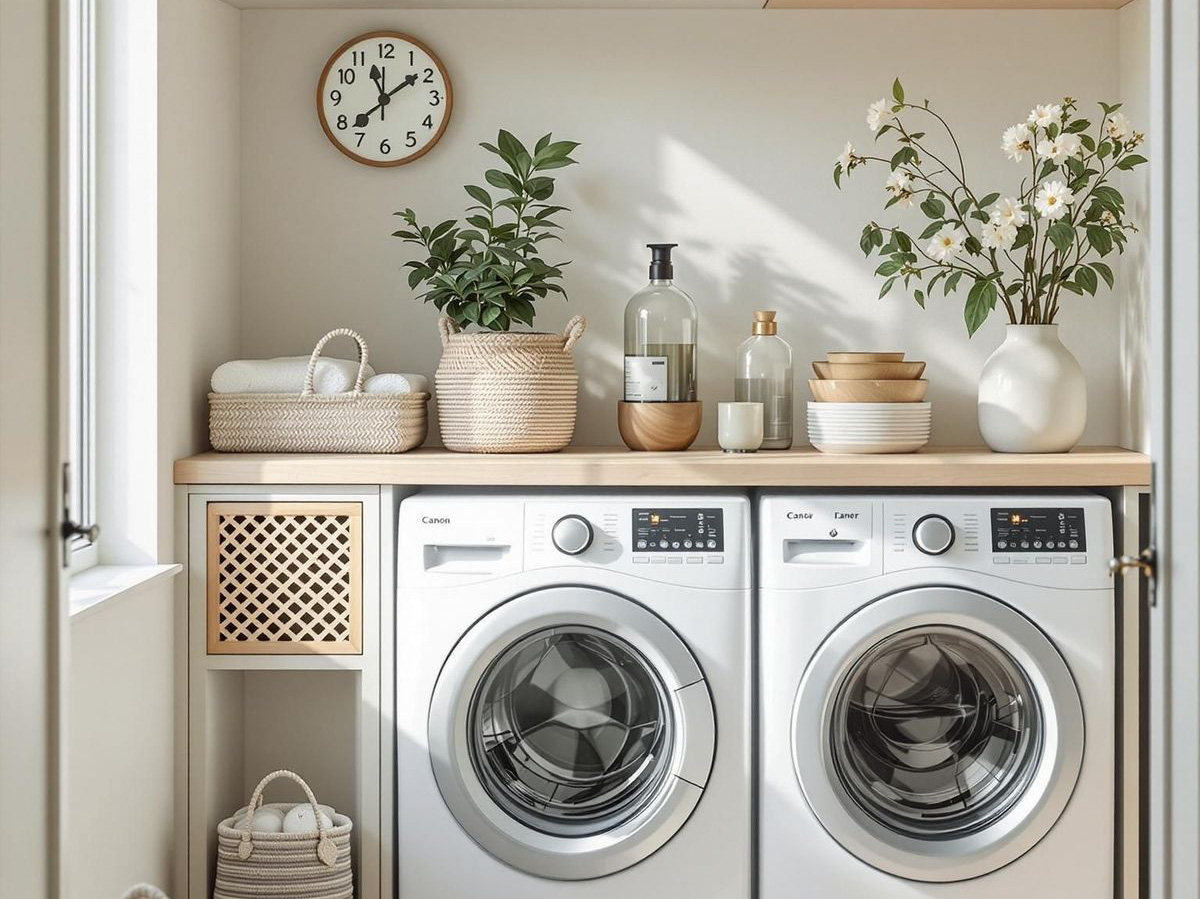
Many times we do not give importance to the service area, but this space must be well designed, not only thinking about the furniture but also its covering and lighting. Generally, we value the environments where we are going to receive visitors, but we also have to think about our day-to-day life, and that we have to feel good in every room of the house/apartment, right?

How to configure the service area
With living spaces getting smaller, planning before buying furniture is essential—especially in the service area, where space is limited and you need to store many items. To make this space practical, organized, and pleasant, here’s a step-by-step guide.
Preparation
Start by checking the location of water and drain points for the sink (or tank), washing machine, and dryer. This will help you determine how much space these appliances will occupy.
Also, check how the machines open—measure the clearance needed for doors or lids to avoid problems during use.
Next, decide on your clothesline type before purchasing furniture.
- Ceiling models: Ensure they can lower and raise freely without hitting cabinets.
- Wall or floor models: Great alternatives for tight spaces.
By defining these elements first, you can choose furniture that fits perfectly without future headaches.
Main furniture
As for practicality, so that your service area is perfect, and for maximum functionality, try to include:
- A space for dirty laundry
- A place for clothes waiting to be ironed
- A hanger or rack for freshly ironed clothes
If space is limited, use mobile baskets, hooks, and foldable solutions.
A workbench for folding and ironing is a big plus. Some units even come with an integrated ironing board—perfect for quick touch-ups and saving space.
Don’t forget storage for cleaning tools like brooms, vacuum cleaners, ladders, and buckets. Multipurpose cabinets are ideal for keeping everything organized.
For the sink/tank:
- Ceramic models are bulkier but can be installed independently.
- Stainless steel models save space but usually require a countertop. Choose based on installation urgency, available space, and style.
If there’s still room, consider adding a shoe rack for recently worn shoes to air out.
When furnishing the house, the service area is usually the last, but have you ever thought that you pass by it every day? So how about making this a practical and enjoyable environment? When structuring your service area, don’t forget to choose the right lighting and coverings for this environment. Remember that every detail makes a difference.
How to cover and illuminate the service area

Many times we do not give importance to the service area, but this space must be well designed, not only thinking about the furniture but also its covering and lighting. Generally, we value the environments where we are going to receive visitors, but we also have to think about our day-to-day life, and that we have to feel good in every room of the house/apartment, right?
Coverings and Lighting
Covering Options
Glass Inserts: The inserts can be colored to make the environment more relaxed and more stimulating for any work to be done in the service area. You can use inserts above the countertop, with a horizontal stripe. If you have a piece of furniture above the countertop, between it and the countertop you can also complete it with inserts. Colorful tiles can brighten the space. Use them as a backsplash above the counter or in accent strips.
Polyurethane Panels: For those who like something cleaner and more sophisticated, the suggestion is the white polyurethane plate, about 30X30cm, manufactured with exclusive technology for recycling polyurethane waste. Cleaning should be done with a soft sponge moistened with water. Sleek, modern, and easy to clean. Often made from recycled materials.
Vinyl Panels: For those who want a more welcoming environment, the suggestion is the standard vinyl floor, which reproduces wooden planks. It looks great applied to the wall, as a covering. Cleaning is simple, it is done with a soft sponge moistened with water. Imitating wood, they add warmth and can be applied to walls as well as floors.
Lightning
With a good covering, we can create an even more pleasant environment with adequate lighting. In addition to general lighting, we can add decorative lighting, highlighting the different coverings of the environment.
General lighting
General lighting is that which is located in the central point of the service area, with cold light, and which is not directed. LED ceiling lights can be used, for example, with a color temperature greater than 4000K. The advantage of the LED ceiling light is that in addition to saving energy, it has a longer useful life because it is LED. This ceiling lamp does not create a shadow area on the luminaire, which creates a very interesting effect.
Decorative lighting – LED strip
For cozier lighting, it is ideal to use an LED strip with a color temperature of 2700 or 3000k, which produces a more yellowish light. You can place it under the upper cabinet, for example, and it can be plugged in or activated by a switch. Being in the socket, there is no need to hire an electrician, you can install it yourself, interesting, right?
Decorative lighting – Pendant
If your service area has a countertop without a cabinet above it, you can dare to place one or several small pendants that illuminate the countertop area. It will be a well-directed light and a decorative element in your environment. It is important to put a lamp with a warm color, I suggest a 2700 or 3000K LED.
Decorative lighting – Spot
If you have plaster in the service area, you can continue using recessed spotlights with a PAR20 2700/3000k LED lamp above the countertop area. Important: If your central luminaire (general lighting) is round, use a round bulb, and if it is square or rectangular, use a square bulb.


